
The Framework Underneath the Work

Most places are built around one kind of brain. One way of taking in information, one way of talking, one way of recovering when a day gets too much. Nobody wrote that down. That is why it is so hard to see.
The Belonging Model calls this neurotype exclusion: work designed on the assumption that everyone processes, communicates and regulates the same way. It sits at the level of the system, not the person. The question is always what the place is doing, not what the person should put up with.
The answer is neuro-equal design: work that treats every brain type as natural variation, so systems, environments and expectations are not built around one kind of brain. The Belonging Model puts that into practice through five pillars, six levels, three layers of work, one pathway of four stages, and a repair loop. Same shape in a workplace, a school, a hospital or a community group. Only the examples change.
Where the Problem Lives
Over time the words changed but the belief stayed the same. The person who did not fit was the one who was broken.
The Belonging Model asks one question of any way of thinking about difference: where does it say the problem lives?
In the soul
Sin, moral weakness, punishment. Difference is treated as moral failure, and the response is correction, concealment or exclusion.
In the brain
Pathology, defect, disorder. The vocabulary becomes clinical rather than moral, but the person is still made the site of the fault.
In the barrier
The issue is no longer the person's difference, but the systems, norms and environments that turn difference into disadvantage.
In the fit
Built on the social and human rights models. It asks what happens in the space between a person and the conditions they are asked to survive.
It moves the problem to the one place that can be changed
Every earlier model put the problem inside the person, which leaves a workplace, a school or a service dealing with people one at a time. The Belonging Model puts it in the fit between a person and the place. The place is what gets designed, so the place is what can change. Overload becomes a design signal instead of a personal failing.
Not: what is wrong with this person?
But: what has this person been forced to survive, and what has the system kept misnaming?
Five Pillars
Difference is natural
Healthy variation, not a deviation to be corrected.
The problem lives in the fit
Between the person and the conditions, not inside the person. The intervention belongs in the design.
Equal dignity
Equal dignity of all lived experience. Nobody's account is worth less.
Harm is the doorway
Naming harm is the beginning of repair, not the end of a relationship.
Whole-self belonging
Connection without a cost of admission. A person able to exist at their actual size, unmasked, without bracing. Not fitting in.
Six Levels
The levels say where to look. Harm rarely sits at only one.
- 1. Self
What a person has internalised about whether they belong.
- 2. Relationships
The settings a person is directly in. Home, team, classroom, clinic.
- 3. Connections between the settings
Whether those settings talk to each other, and what falls through when they do not.
- 4. Services and systems
Policies, funding, and decisions made elsewhere that shape what is available.
- 5. Culture
Dominant narratives about difference and who counts as normal.
- 6. History and power
Accumulation over time, of exposure, of dismissal, and of who has had power throughout.
The six levels adapt Bronfenbrenner's ecological systems model, a way of mapping the layers around a person from family out to culture and history, with a sixth level added at the centre for what a person has internalised about their own belonging.
Who Carries the Cost
Stacked load
Neurotype exclusion rarely arrives on its own. It stacks with race, class, gender, sexuality, disability and money, and the stack is not a sum. A person carrying several of these does not get three sets of barriers added together. They get something different in kind, pressing on a nervous system already carrying the rest. A plan built for one label will miss it every time. The model calls this stacked load, and the wider idea is intersectionality.
Who goes first
The cost of saying so depends on where you sit. A principal can change the rule. A worker who names it may be read as difficult. A student who names it may be called defiant. The less power a person holds, the more it costs them to speak, so the place goes first. Not an open door. Changes made before anyone asked, errors named before anyone caught them, and a visible record of what happened to the last person who raised something. The model calls this who goes first. Where you sit is your positionality.
Three Layers of Work
Belonging is produced, or eroded, at every layer at once. These are not separate conversations.
Body first, story second
A person learning how they take in information, carry sensory load and recover. What drains them, what restores them, and what they can carry on a given day, rather than what the place assumes they can carry.
Belonging is built between people
Listen first, advise second. Say things plainly instead of expecting people to read between the lines. When something goes wrong, admit it and fix the cause. All three can be taught.
Design decides what people can do
Find what in the design does harm, and change it. Build for the full range of people first, then adjust for individuals. Bring neurodivergent people in when something is being planned, not to review it at the end.
See how these three layers shape the design in the workplace, health services, education and community settings.
One Pathway, Four Stages
The four stages build on each other. Nothing at stage three holds if stage two has not happened. It is not a race, and a person or an organisation can sit at different stages across different areas at the same time.
Harm
Name what is actually happening, and to whom.
Take the pressure off
Some people perform well under load, and pay for it afterwards. Nothing built at the next stage holds while the load stays on.
Change what can be changed
Redesign the parts of the place that can be redesigned. Say plainly which parts cannot, and why.
Belonging
People doing what matters to them, trusted and relied on by the people around them.
Ready to See This in Your Own Setting
A thirty-minute conversation on what is happening, and whether this fits.
What Happens When Something Goes Wrong
Something will go wrong eventually. The question is whether a way to put it right already exists before it is needed.
- 1Check in
Regular and routine. What is and is not working, named before anything breaks.
- 2Notice the break
Heard and named, without denial or shame. The person is believed first, not investigated first.
- 3Pause
Do not try to fix it in the same moment it happens. Anything agreed while people are still upset tends not to stick.
- 4Talk it through
What happened, and what it cost. Honest, not softened. An ordinary conversation, not an exceptional one.
- 5Repair
Change the thing that caused it, not just an apology. An apology leaves the conditions exactly as they were.
- 6Show it stayed
Trust comes back when people can see the change stayed.
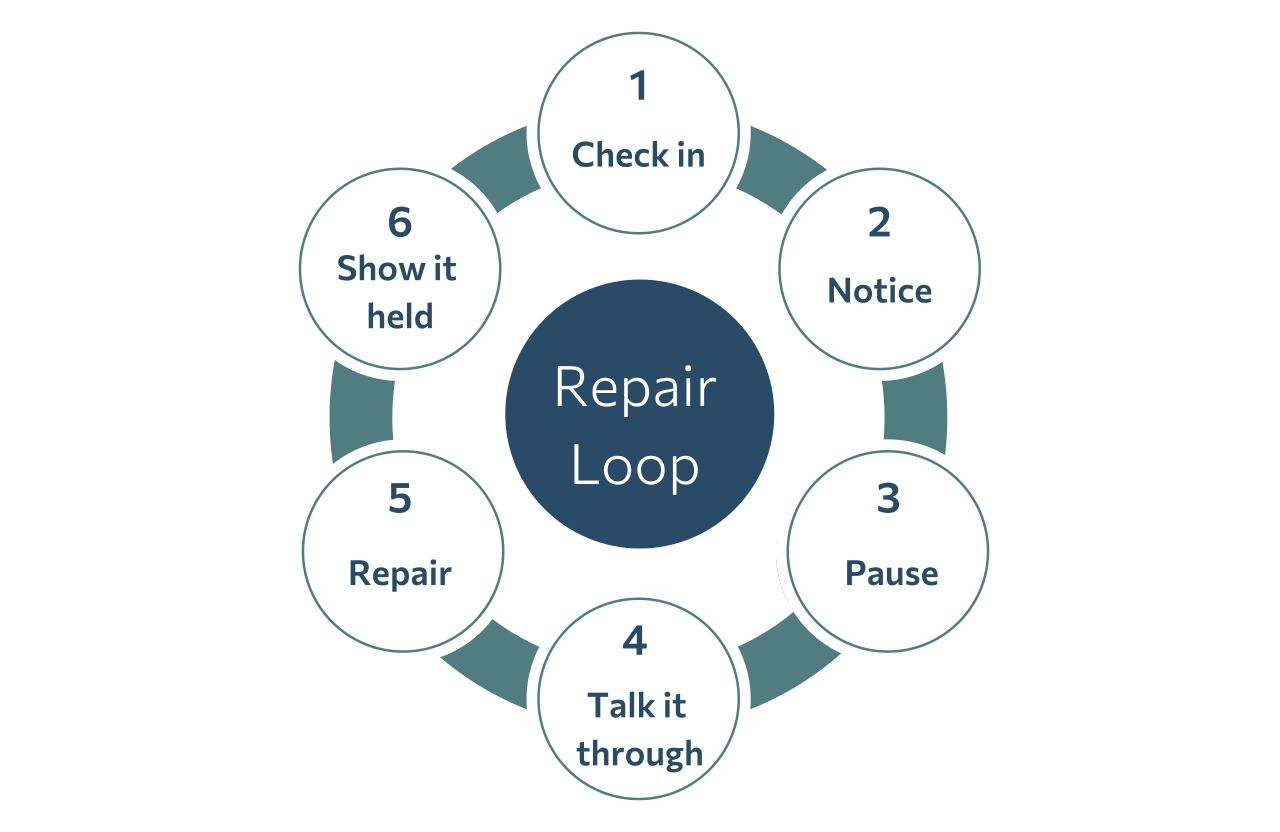
Believed first means the report is taken as information, not as a finding. Where an investigation is owed, it still happens. It just does not happen to the person who spoke.
There is no fixed starting point. A place starts where it is.
Where there is no way to put things right, nothing stops. People pull back, then leave, and the reason gets recorded as something else.
What the Model Does Not Claim
Some things cannot be changed. Night shift. Bell times. A waiting room that cannot move. A deadline set by someone else. The model does not claim every condition can be redesigned for every person.
Where that is true, three things are still owed.
- Say so plainly.
- Do not turn it into the person's failing.
- Plan for the harm it causes, before it happens.
Do those three things and it is a real limit. Skip them and it is a choice not to change.
Which Setting Is Yours
The model is the same in every setting. The examples change. Pick yours.
In a workplace the model runs inside the Psychosocial Risk Review and the Design Partnership. Pricing on request.
Belonging in the Workplace
For WHS, HR and people leaders, managers and workers. Neurotype exclusion found inside the hazard register you already hold.
Belonging in Education
For school leaders, teachers, support staff, parents and students. One design for everyone in the building.
Belonging in the Health Sector
For boards, clinical leaders, people and culture teams and colleges. The work is examined, not the clinician.
Belonging in the Community
For allied health, advocates, mentors and people with a platform. Belonging as prevention.
Who Built It
The Belonging Model was developed in Australia by Sarah Eagle, founder of Joy Diving Australia, from more than 25 years of lived experience, practice and research.
