
A community setting is a lot of people with one thing in common. A sports club, a council service, a library, a support group, a faith community, a festival, a volunteer crew.
What makes it different from work or school is that nobody has to stay. People come because they want to be there. When a place is built around one kind of brain, people do not complain. They stop coming, and the reason is never recorded.
The Belonging Model treats this as a design problem, not a person problem. What locks one neurotype out of the meeting usually locks the same neurotype out of the event, the sign-up and the committee. So the model uses one design for everyone who walks in. The full model, its five pillars, six levels and repair loop, is on the framework page. This page is the community.
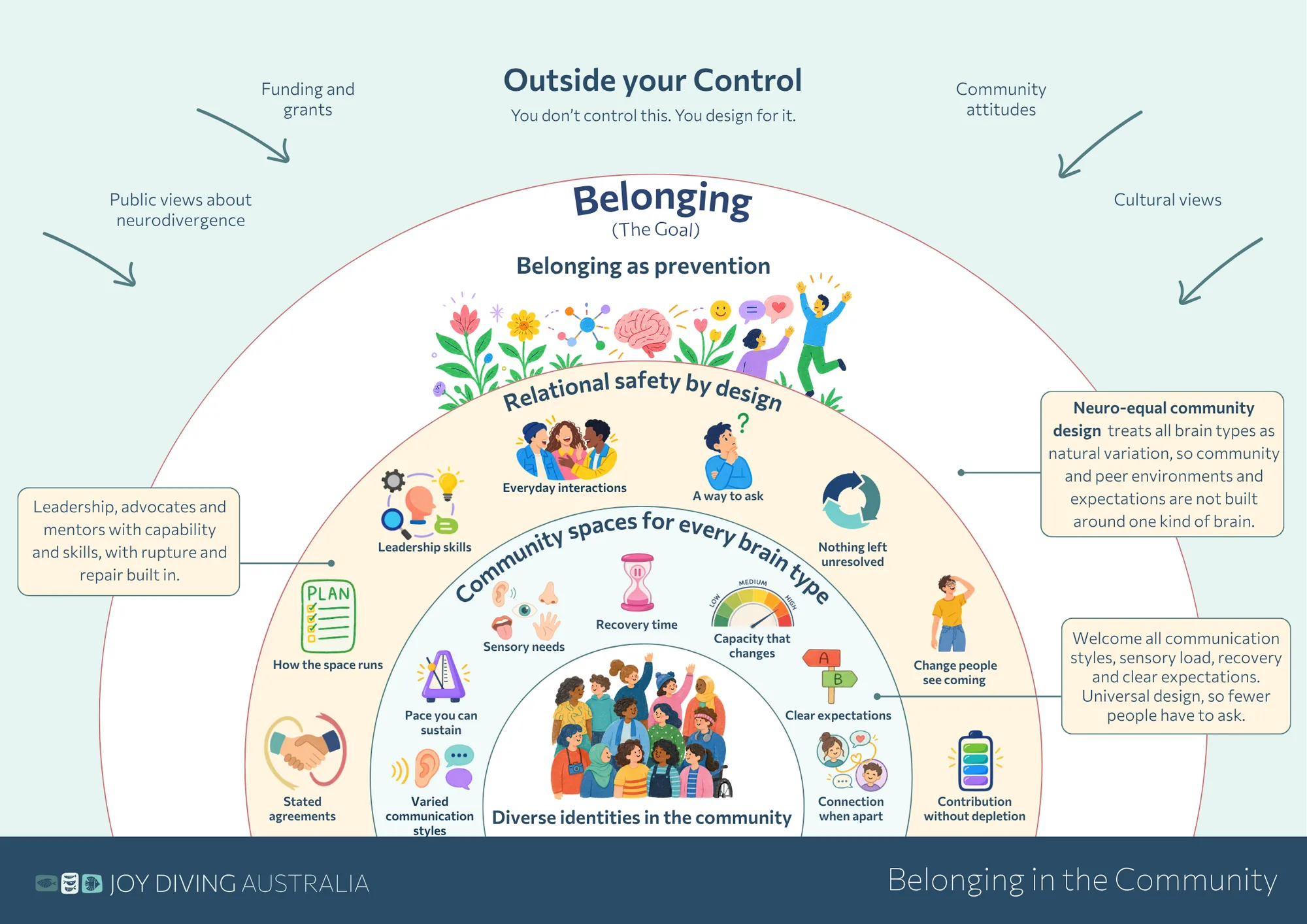 Tap the diagram to open it full size
Why the Outer Ring Says Prevention

In every setting the outer ring is belonging. In a community setting it is also the whole point, because belonging is the thing a community is for.
The harm on the other side is isolation. People who have nowhere they can be themselves, no group that expects them, nobody who notices when they stop coming. A community setting that is designed for every brain type is not doing something extra. It is doing the one thing it exists to do, for everyone who walks in.
That is why it reads prevention. A place that people can stay in prevents the harm that comes from having nowhere to go.

What Gets in the Way
Around 15 to 20 per cent of the population is neurodivergent (Doyle, 2020). That covers the committee, the volunteers, the members, the families at the gate and the people who never made it through the door. Most have never told anyone, so no list will tell a setting who is carrying the load.
None of this was deliberate. It shows up in ordinary decisions that are not questioned.
- Announcements over the PAThe room change is said once, out loud, in a hall. The person who needed it written down turns up to the wrong room and is marked as not listening.
- Go round and introduce yourselvesNo agenda sent, no option to pass. The person who processes in writing arrives cold, says nothing, and is read as not interested.
- Sign up by phoneEvery query is a call. The person who can only manage it in writing does not sign up.
- Three hours, no break, nowhere quietThe event runs straight through. The person who needs ten minutes out either leaves early or does not come back next time.
- Volunteers briefed on the dayOnce, spoken, in a rush. Nothing written to check against, so the same question gets asked three times and read as not coping.
- Rules everyone is meant to already knowWhere to sit, when to speak, what counts as welcome. Nobody says them out loud, so the person who needed them said gets them wrong.
- The feedback form only asks what went wellNothing asks what shut people out. So nothing is heard, and nothing changes.
- The only path is a complaintThere is no way to say this is not working before it becomes a formal complaint to the committee. By then the person has usually already left.
None of it was meant to shut anyone out.
A member who stops coming. A volunteer who is always the reliable one until they suddenly are not. A parent who never joins the committee. A person who comes once and does not come back. Seen one way, these are choices belonging to a person. Seen through the Belonging Model, they are what people do to get through a place that was not built for them.
Change the design, and the setting changes the conditions that produce them.
Who Feels Safe Enough to Come Back
A community setting has no roll. Nobody has to stay. So the person who cannot make the design work leaves, and the reason is never recorded.
Positionality is where a person sits in a setting, and how that shapes what they notice, what they assume, and what they can safely say. A committee member can change the rule. A long-standing member can raise it in a meeting. A new volunteer who names it may not be asked back. A first-time visitor who names it has already decided not to return.
Same problem, four positions, four different costs. The less power someone holds, the more it costs them to speak. That is why the setting goes first. A way to say "this is not working" that costs the person nothing, and does not depend on them coming back to use it.
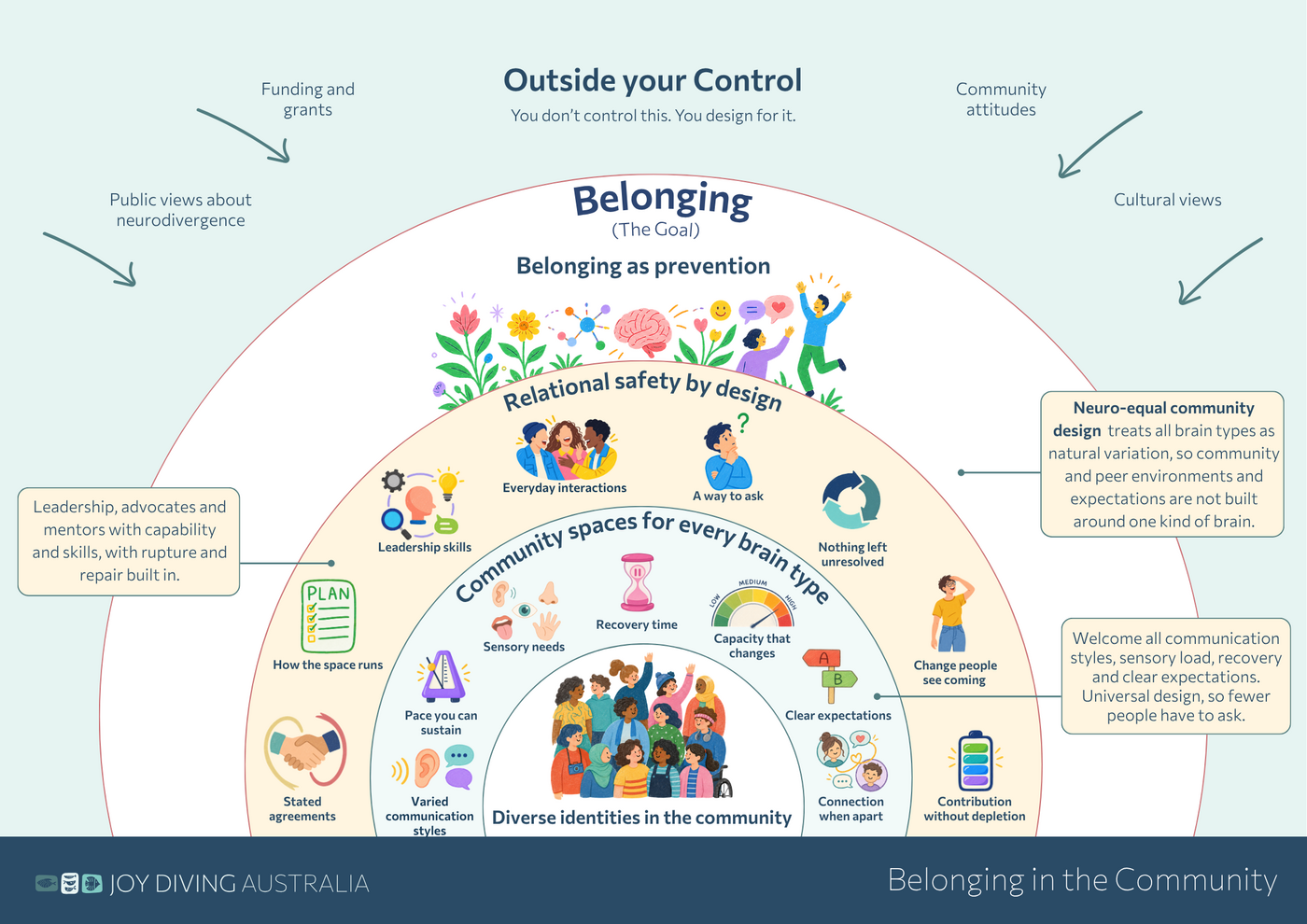
For the wall
Put the Belonging Model on Your Wall
A print-ready A2 PDF of the framework you just read, applied to community settings. Includes both a full diagram for study or training and a simplified version for the wall. Personal or organisational use. $29.
See the Community PosterWhat a Community Setting Can Do About It
Keynote, training and workshops for committees, staff, volunteers and members, using the Belonging Model.
A design review of how a setting's existing setup affects people of every neurotype. It starts small. One review of one thing, the sign-up, the monthly meeting or the annual event, and a short list of what to change.
For a festival, conference or public event, our Events service does the same read on the event itself.
A community organisation is also a workplace for its staff. For that side of the same design, see Belonging in the Workplace.
Pricing on request
Funded through inclusion grants in many cases
Who This Is For
Committees and Community Leaders
Who run a club, a service, a group or a congregation and want fewer people quietly leaving.
Frontline and Volunteer Staff
Who are the ones people meet at the door, and want the design to carry what they are carrying alone.
Allied Health and Advocates
Who see the same people shut out of the same places, and want a model to point at instead of explaining it again. Send this page to the service.
Neurodivergent Leaders and People with a Platform
Who are asked to represent, and want something to hand over that says it for them.
Who Built It
The Belonging Model was developed in Australia by Sarah Eagle, founder of Joy Diving Australia, from more than 25 years of lived experience, practice and research.
