
What Neurodiversity in the Workplace Actually Means

Neurodiversity describes the natural range of how human brains think, sense, focus, communicate, remember and recover. It is a fact about populations, not a programme. Every workplace already has it.
Neurodivergent describes an individual whose processing sits outside what the work was built to expect. Autistic people, ADHDers, dyslexic and dyspraxic people, people with Tourette's, people living with the effects of acquired brain injury or long-term illness. Some people name themselves. Most do not.
So neurodiversity in the workplace is not a group of employees to be managed. It is a design question. Work built on the assumption that everyone processes information the same way will keep producing the same problems, and those problems will keep being described as people problems.
That shift is the whole point. Once the work is the subject, nobody has to identify themselves for anything to improve.
How Many People This Involves
Around 15 to 20 per cent of the population is neurodivergent (Doyle, 2020). In a workforce of two hundred, that is thirty to forty people.
of your workforce is neurodivergent. Most of them have not told you.
Your adjustment register will show a handful. Your engagement survey will show a gap it cannot explain. Neither is measuring the group. They are measuring the people who judged it safe enough to say something.
Which means the honest starting position for most organisations is this: you do not know who, you do not need to know who, and you can still change the conditions.
Why the Usual Approach Stalls
Most organisations start in one of three places. Awareness training. An employee network. An adjustment process. All three are worth having. None of them changes the design of the work, so all three plateau.
Awareness sessions explain the range of human processing to managers who then return to a rostering system, a recruitment process and a meeting culture that has not moved. The knowledge has nowhere to land.
Networks depend on people identifying themselves. In workplaces where disclosure carries a cost, the network becomes a small, brave subset, and its absence of complaints gets read as an absence of problems.
Adjustments are handled one person at a time. When the eleventh person asks for the same thing, that is no longer an individual need. It is a design fault being paid for eleven times over, through eleven separate negotiations, each one requiring somebody to explain themselves.
The pattern underneath all three is the same. The person is the unit of change, and the work stays exactly as it was.
Where It Shows up in the Design of Work
These are the places the same problems keep arriving from. None of them is about an individual.
Recruitment and selection
Unstructured interviews that test conversational improvisation rather than the job. Questions sent seconds before an answer is expected. Assessment stages that measure stamina for the process.
Information and instructions
Briefings given once, verbally, at pace. Expectations held in someone's head. The same information entered in four systems. Decisions nobody wrote down.
Sensory conditions
Open-plan floors with no quiet option. Lighting and noise nobody chose. Buildings that cannot change this year, in which small changes still matter.
Meetings and communication
One channel treated as the only professional one. Cameras assumed. Thinking time treated as hesitation. Agendas arriving during the meeting.
Rosters, load and recovery
Rotating patterns that remove control over sleep. Back-to-back days with no recovery built in. Peak demand that is planned for and still described as unexpected.
Change and uncertainty
Restructures announced without sequence or timing. Systems replaced without practice. Change people cannot see coming has a cost, and the cost lands unevenly.
Feedback and performance
Feedback delivered as tone rather than content. Behaviour rated as attitude. Conversations about a person where a conversation about the process would have solved it.
Asking for anything at all
The single most telling one. How an adjustment is requested, who hears about it, how long it takes, and what it costs a person to ask. When asking is expensive, people stop asking, and the register looks reassuring.
No regulator lists this as a hazard in its own right. It still produces psychological injury, and it sits inside hazard categories organisations are already managing. More on that, on Belonging in the Workplace.
A Framework for It: The Belonging Model
Joy Diving Australia works from The Belonging Model, developed in Australia from more than 25 years of lived experience, practice and research.
The model names the underlying problem as neurotype exclusion: work designed on the assumption that everyone processes, communicates and regulates the same way. Not hostility. Not a lack of goodwill. An assumption built into systems by people who never had reason to question it.
It then separates two things most conversations collapse together. Compliance is the floor. Belonging is the goal. Meeting an obligation and designing work people can actually do are not the same project, and only one of them changes what happens on a Tuesday.
The diagram holds the whole thing in one picture: everything inside the rings is something an employer designs, and everything outside them is not.
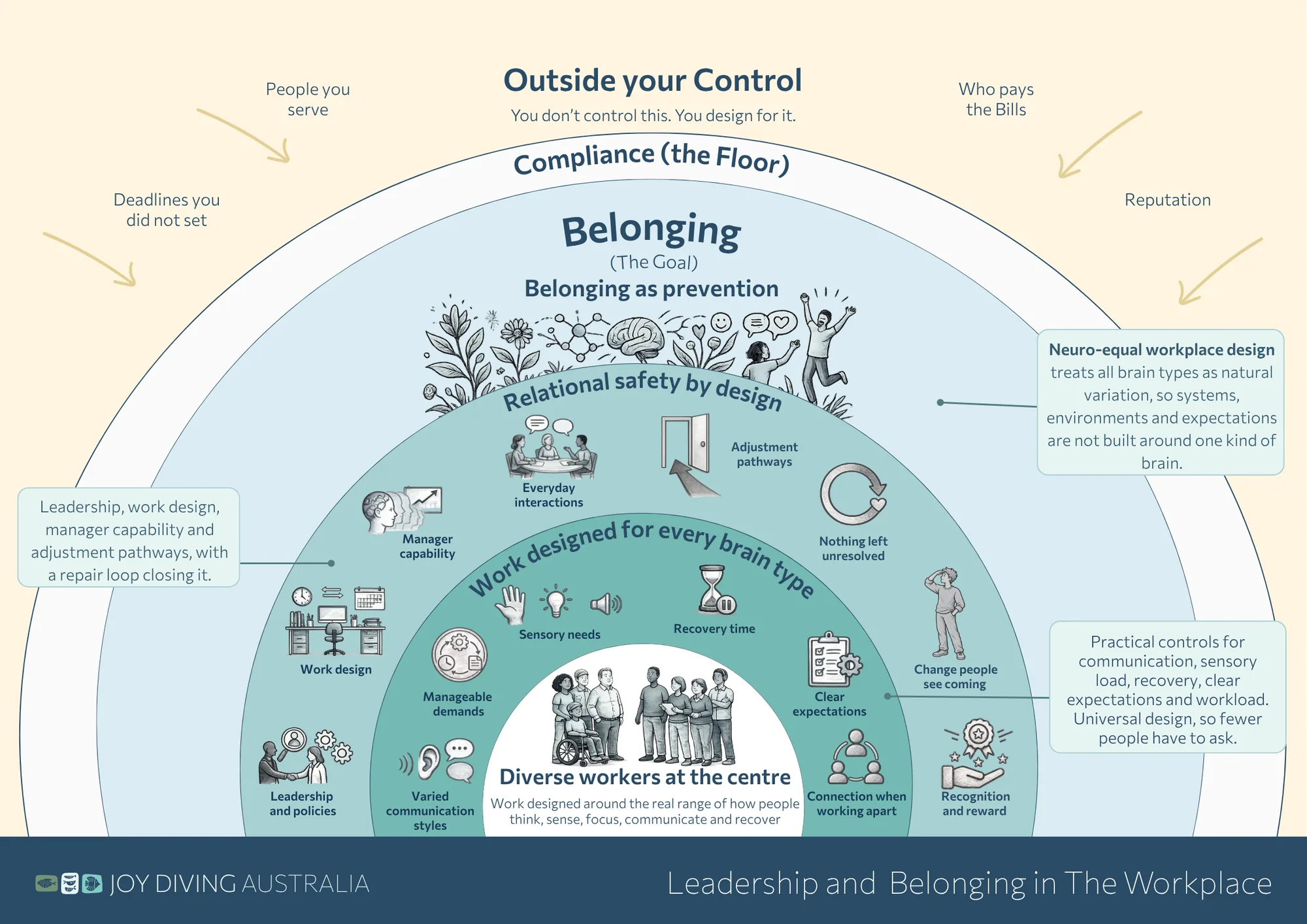 Tap the diagram to open it full size
The model is also written up for the health sector, education and community settings. The research behind it sits on The Evidence.
What Changes, in Practice
None of this requires knowing who is neurodivergent. All of it helps everybody, and it helps some people enormously.
Write things down. Expectations, decisions, sequence, timing. If it only exists in a conversation, it only exists for the people who process conversation easily.
Send information before you need a response. Agendas, questions, briefs. Thinking time is not hesitation, and processing speed is not capability.
Structure recruitment. Same questions, sent in advance, scored against the job. It narrows the gap between interviewing well and working well.
Give people more than one way to do the same thing. One way to communicate, one way to sequence work, one place to sit. Choice costs less than negotiation.
Build recovery into the design. Not as a perk. As part of how load is planned.
Make change visible early. What is changing, when, and what stays the same.
Make asking cheap. One clear route, a short timeframe, no need to explain a diagnosis, and no record following anyone around.
Stop solving the same thing individually. When a request repeats, change the design instead.
Joy Diving Australia looks at the work, not at individuals. No screening, no disclosure, no diagnosis, and no health information collected or held.
Where Organisations Start
Consultancy
A review of how the work is designed, mapped to named psychosocial hazards. For executives and people and culture leads deciding where to intervene first.
Environment
Sensory and workspace review of the floors, meeting rooms and quiet spaces people actually use. For facilities, operations and property.
Capability
Manager training in psychosocial safety and neuro-equal work design. For the layer that either holds the design or quietly works around it.
Ongoing
A twelve-month redesign engagement rather than a one-off report. For organisations rebuilding structure, not running an awareness campaign.
There is also event and conference work, and a keynote if you need the room to understand the problem before the work begins. All of it is listed on All services.
Questions Employers Ask
Do we need to know who is neurodivergent?
No. Nothing here depends on it. Asking people to identify themselves shifts the cost onto them and produces worse information than looking at the work does.
Isn't this just accommodations?
Adjustments respond to one person at a time, after the fact. Work design changes the conditions that generated the request. You still need an adjustment pathway; you need it far less often.
Where does compliance fit?
Compliance is the floor. Joy Diving Australia does not certify compliance, conduct work health and safety audits, or provide compliance advice. The work is about how the work is designed, alongside whatever obligations your organisation already manages with its own advisers.
How is this different from awareness training?
Awareness explains the range of human processing. Design changes what the range meets when it arrives. Training is most useful once there is something built for managers to hold.
Is this only for large organisations?
No. Smaller organisations often move faster, because fewer people have to agree before something changes.
I am a worker, not an employer. Is there anything for me?
Yes. The For Workers guide is written for you. Joy Diving Australia works with organisations and does not provide one-to-one support or act as an advocate in disputes, grievances or claims.
For the wall
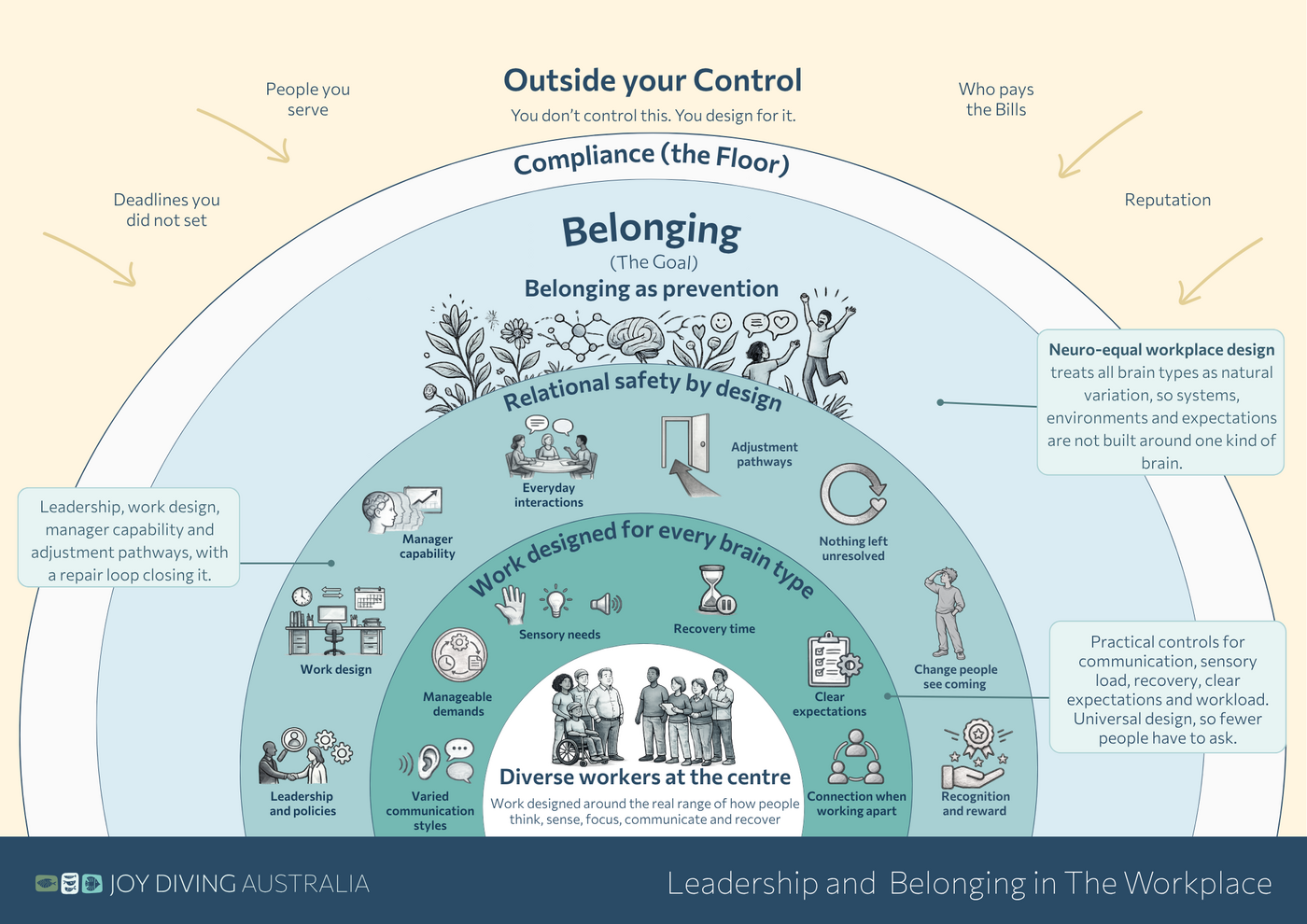
Put the Belonging Model on Your Wall
A print-ready A2 PDF of the framework you just read, with both a full diagram for study or training and a simplified version for the wall. Personal or organisational use. $29.
See the Workplace PosterStart with a Conversation
Thirty minutes on what is happening in your organisation, and whether this fits. No form to fill in first.
Worth knowing before you call
These conversations are for organisations. Joy Diving Australia does not provide one-to-one support to individual workers, and does not act as an advocate in disputes, grievances or claims. If you are a worker looking for support, the For Workers guide is out in November. You can join the wait list on that page.
Who Built It
The Belonging Model was developed in Australia by Sarah Eagle, founder of Joy Diving Australia, from more than 25 years of lived experience, practice and research.
