
Your Workforce Data Has a Hole in It

Health services carry a specific version of this problem.
For anyone whose work depends on registration, disclosing a diagnosis can feel like putting a career in someone else's hands. AHPRA's mandatory-notification threshold is high, but the fear is real. A notification. A question at credentialling. A note in a file that follows them to the next appointment. It holds for doctors, nurses, midwives and paramedics, and across allied health for occupational therapists and pharmacists. The fear does not have to be accurate to change what people do.
Speech pathologists sit outside national registration and answer to their own professional body instead, which changes the exposure but not the silence.
So they say nothing. They answer the culture survey carefully, or not at all. The same holds for staff on rotation, on short contracts and in training posts, where saying the wrong thing costs a reference.
Around 15 to 20 per cent of the population is neurodivergent (Doyle, 2020). In health services most of that group stays invisible to you, and the system is what keeps them that way.
of your workforce is neurodivergent. Most are invisible to you.
You are not measuring your workforce. You are measuring the part of it that feels safe enough to answer.
The Belonging Model calls this neurotype exclusion: work designed on the assumption that everyone processes, communicates and regulates the same way. In health services, the disclosure risk is what keeps it invisible. The full model is on The Framework.
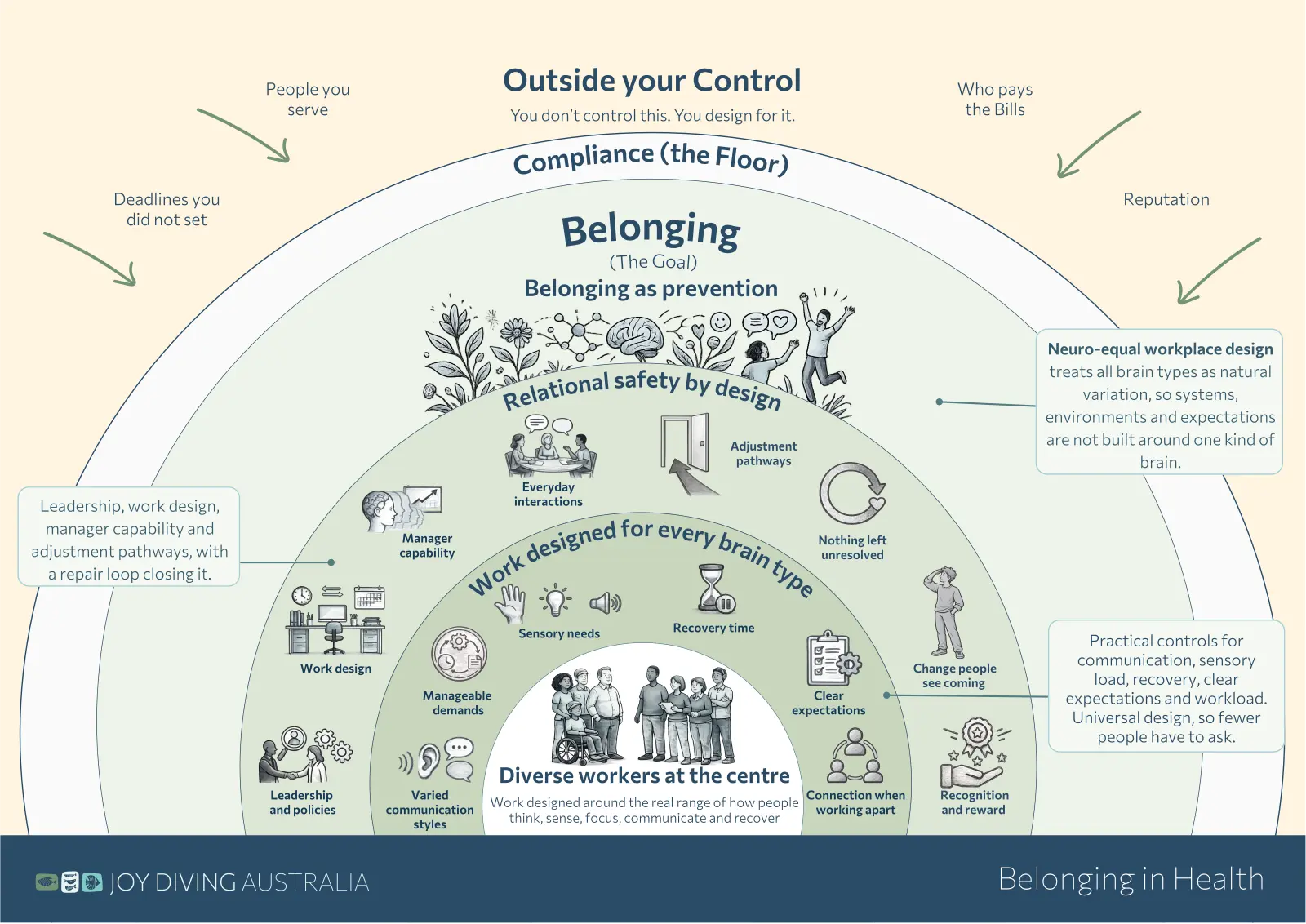 Tap the diagram to open it full size
What the National Model Asks of Your Board
In 2026 the Australian Commission on Safety and Quality in Health Care published the National Model for Clinical Governance, replacing the 2017 framework. Two of its foundations sit directly on this.
Foundation 1, Leading systems and organisational culture: reflects the board and executive's WHS duty to provide a psychosocially safe environment for the workforce and patients.
Foundation 3, Building a healthy workforce culture: the board, executive, clinical leaders and managers are responsible for workforce health and wellbeing, systematically measure workforce culture including psychosocial safety, and act on the findings. Its warning signs include low response rates to staff surveys and poor engagement with safety culture questions not being recognised as risks to patient safety.
The six foundations will structure the Clinical Governance Standard in the third edition of the NSQHS Standards.
Read that next to the disclosure problem. A low response rate is not apathy. It is a workforce that has done the maths.
The Hazard Was Never the Worker
The registrar described as difficult in handover. The occupational therapist whose reports are always late and whose patients always improve. The nurse who is fine on nights and struggling on a rotating roster. The trainee who has asked the same question three times.
Every one of those is a conversation about a person. Almost none of them is a conversation about the design of the work that produced the behaviour.
Managers in health are told to have a conversation with the individual. They are rarely asked whether the handover, the roster or the assessment process could be built differently. Change the design and the same problem stops arriving.
Compliance is the floor, not the goal. The national model tells your board what it has to measure. It does not tell it what to change.
The Work Is Examined, Not Individuals
No screening, no disclosure, no diagnosis, and no health information collected or held. Nothing goes on anyone's record.
What is examined is the work. Rosters, handover and on-call. Documentation systems, and the number of places the same information has to be entered. Sensory conditions on the ward and in theatre. How feedback is given on a busy shift. How an adjustment is requested, and what it costs to ask.
Nobody has to name themselves to be counted. That is why people take part, and why what comes back is closer to the truth than anything currently held.
What Shows up in Health Settings
Handover delivered once, verbally, at pace, at the end of a shift. Rostering that removes control over sleep and recovery. Documentation built for one way of sequencing. Dispensing work interrupted mid-check, then held responsible for the check. Caseloads written up between appointments, in cars, in shared offices nobody can leave. Training and assessment cultures where asking for an adjustment reads as not coping. Sensory conditions nobody chose, in buildings nobody can change this year.
No regulator lists it as a hazard in its own right. It still produces psychological injury, and it sits inside the hazard categories already being managed. Why that is, on the Belonging in the Workplace page.
Who This Is For
Boards and executives in hospitals and health services. Medical directors, directors of nursing, directors of allied health, heads of department and clinical leads. People and culture teams. Colleges and training organisations carrying responsibility for trainees.
What that turns into is usually one of these. A Psychosocial Risk Review of a service, a directorate or a whole site. A Neuro-Equal Sensory Review of the ward, the theatre suite or the offices allied health works from. A Design Partnership that guides the redesign alongside your leaders. Neuro-Equal Manager Training for clinical leads and department heads. Or a keynote to a college, a conference or a grand round.
Where to Start
Consultancy
Named psychosocial hazard review, mapped to how the work is designed. For boards, execs and P&C leads deciding where to intervene.
Environment
Sensory review and workspace design for ward, clinic, meeting and admin spaces. For facilities, operations and clinical leads.
Capability
Manager training in psychosocial safety and neuro-equal work design. For nurse unit managers, department heads and P&C.
Ongoing
A twelve-month redesign engagement, not a one-off report. For services rebuilding structure over a full clinical governance cycle.
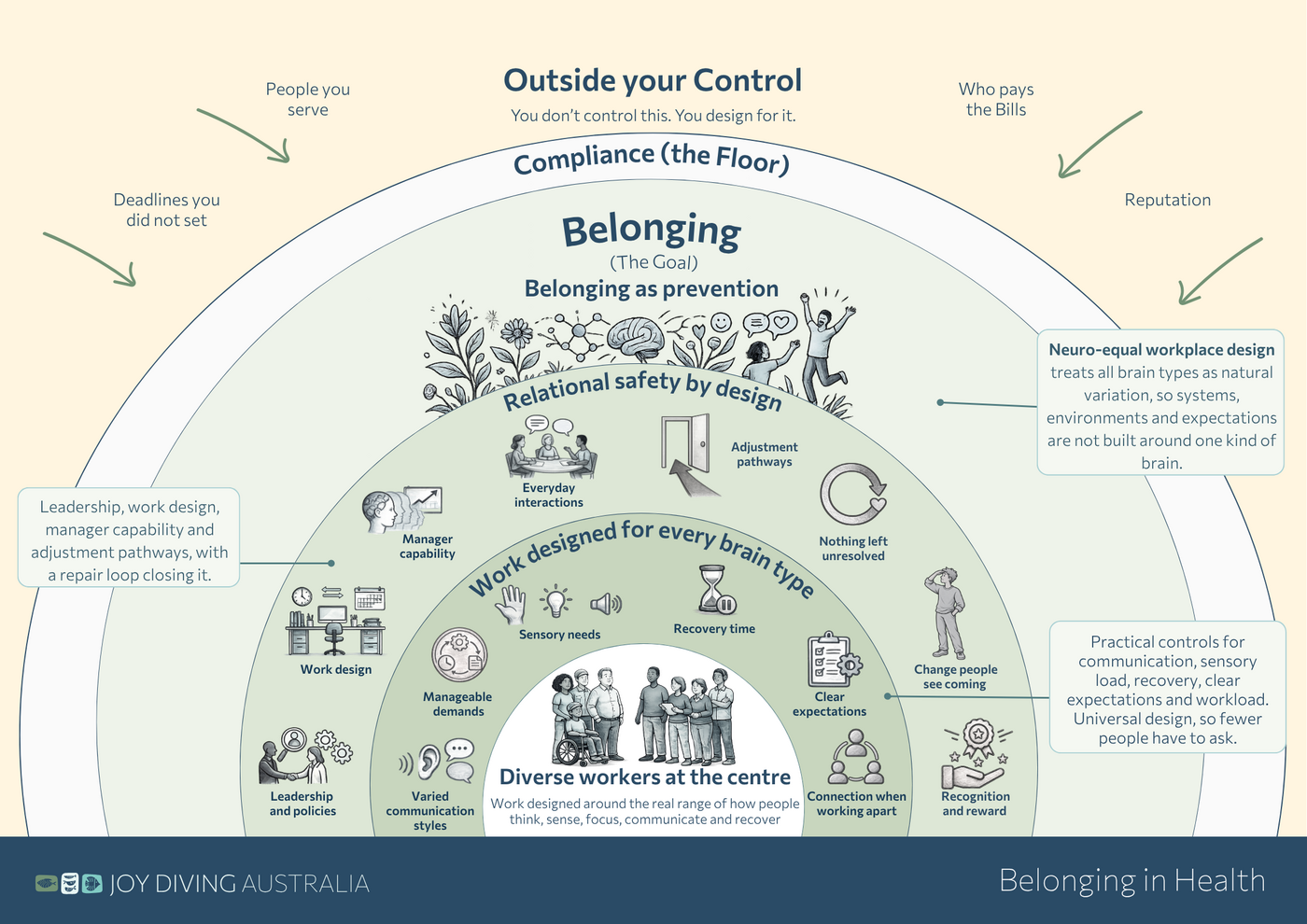
For the wall
Put the Belonging Model on Your Wall
A print-ready A2 PDF of the framework you just read, applied to the health sector. Includes both a full diagram for study or training and a simplified version for the wall. Personal or organisational use. $29.
See the Health PosterStart with a Conversation
Thirty minutes on what is happening in your service, and whether this fits. No form to fill in first.
Before you book
These conversations are for organisations. Joy Diving Australia does not provide one-to-one support to individual workers, and does not act as an advocate in disputes, grievances or claims. If you are a clinician looking for support, the For Workers guide is out in November. You can join the wait list on that page.
Who Built It
The Belonging Model was developed in Australia by Sarah Eagle, founder of Joy Diving Australia, from more than 25 years of lived experience, practice and research.
