
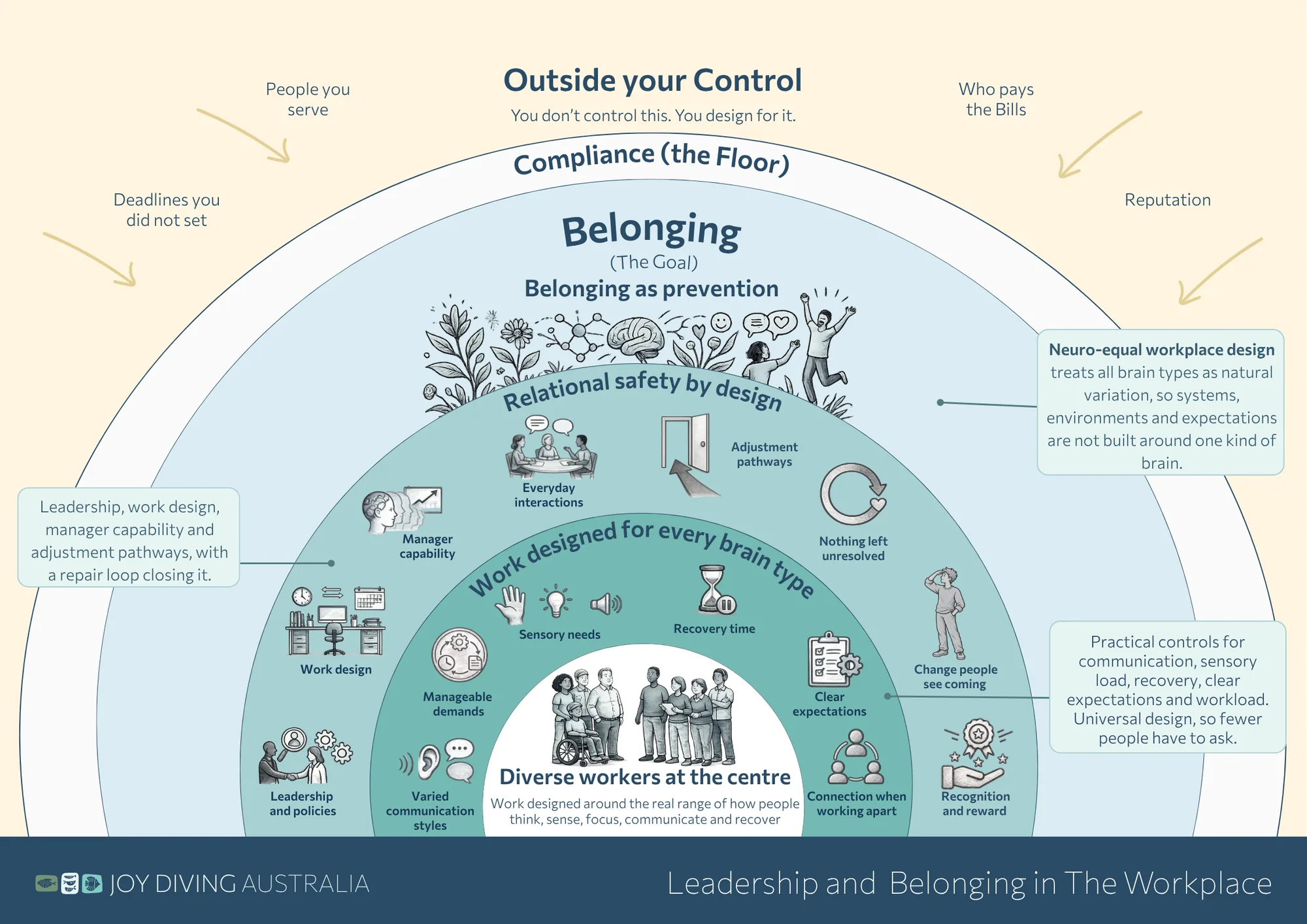
 Tap the diagram to open it full size
Most workplaces are built around one way of processing information, one way of communicating, and one way of recovering from load. That design is almost never written down, which is why it is so hard to see.
Around 15 to 20% of the population is neurodivergent (Doyle, 2020). Most are undiagnosed or undisclosed, so no headcount will tell an employer who is carrying the cost.
The Belonging Model calls this neurotype exclusion: work designed on the assumption that everyone processes, communicates and regulates the same way. It treats that as a work design hazard, sitting at the level of the system rather than the person. The full model, including the neuro-equal design response and its five pillars, six levels and repair loop, is on the framework page. This page is the workplace.
What Gets in the Way

None of this was deliberate. It shows up in ordinary decisions that are not questioned.
- Instructions given once, out loudThe worker who needed it written down is marked as not listening.
- Handover at pace at the end of a shiftRecovery time after distressed customers or traumatic material set by the roster, not by the load carried.
- Open plan and hot-deskingNoise, lighting and no fixed desk exclude before the day starts.
- Portals that hold no memoryForms and approvals that add steps and forget what was already said.
- Change announced without the reasonInstructions that rely on reading between the lines, and a timetable that changes on the day it starts.
- Adjustments that depend on disclosureThen on the manager who receives it.
- Plain speech read as conflictAutistic communication taken as rudeness, and no way to put it right once it is.
- One pattern filed as five performance casesThe same fault recorded person by person, never as one design fault.
None of it was meant to shut anyone out.
Masking. Fawning. Freezing. Hypervigilance. Over-explaining. Compulsive competence. Read through a deficit lens, these are symptoms belonging to an individual. Read through the Belonging Model, they are intelligent survival strategies in environments where dignity and belonging have not been reliably available.
An employer cannot redesign a symptom.
An employer can redesign a condition.
In Your Hazard Register
This part is for the person who holds the psychosocial risk register.
No Australian regulator names neurotype exclusion separately. It does not need to be named separately to be real, or to be an employer's duty. Every Australian jurisdiction describes a psychosocial hazard broadly: anything in how work is designed, managed or carried out, or in interactions at work, that may harm a worker's psychological health. Work built for one kind of brain sits squarely inside that.
Neurotype exclusion does not need its own row to be found. It sits inside the hazard categories you already assess. These are the eight places it shows up, and the hazard each one already maps to. The category names below are the ones used in the model Code of Practice adopted by the harmonised states and territories, and in slightly different words in Victoria's Compliance Code.
Every one of these categories is already on a standard register. What is missing is the read that finds one design fault underneath them.
Naming a pattern is what makes people look for it. Gendered violence is named as a psychosocial hazard in its own right in WorkSafe Victoria's Psychological health compliance code, with its own definition, examples and risk controls, despite overlapping aggression or violence, bullying and sexual harassment.
For the wall
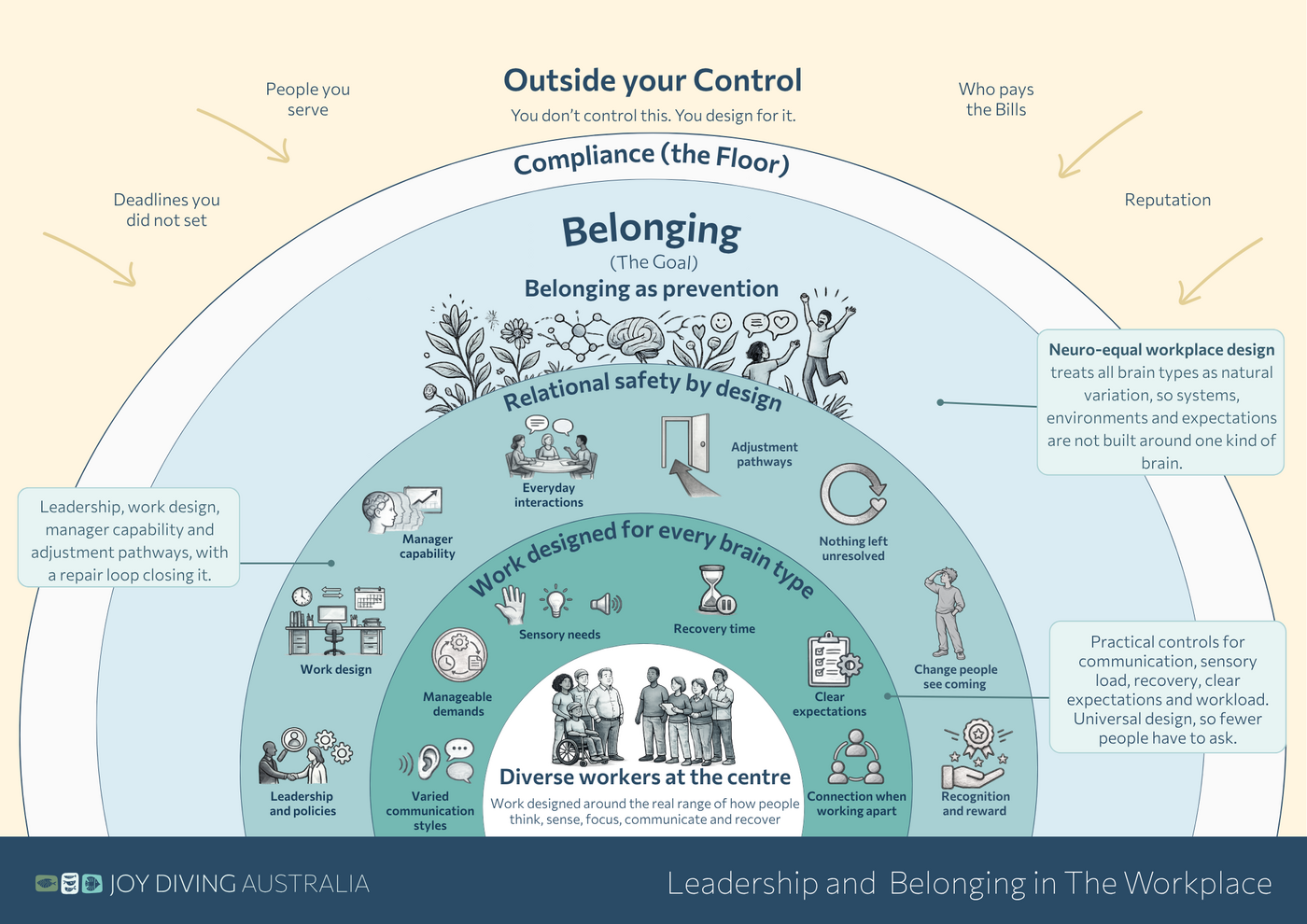
Put the Belonging Model on Your Wall
A print-ready A2 PDF of the framework you just read, with both a full diagram for study or training and a simplified version for the wall. Personal or organisational use. $29.
See the Workplace PosterWhat an Employer Can Do About It
The Belonging Model is not a training topic. It is the method underneath five services, and each service owns one part of the model.
The Consultancy does stages one to three of the pathway. It names neurotype exclusion inside the hazard categories you already manage, says which parts of the work can be redesigned and which cannot, and returns findings written for your register, not a survey score.
The Ongoing partnership runs the repair loop. Step one of the loop is a regular check-in, and that is what a twelve-month retainer is. When something goes wrong during the year, the way to put it right already exists, because it was set up before it was needed.
The Environment and Events services work on the systems. Capability works between people.
Best fit
- Organisations that already hold a psychosocial risk register.
- Sectors where psychosocial risk is a live duty, not a policy document filed once a year.
- Leaders ready to change how work is designed, not add another training day.
Who This Is For
WHS and Risk Leaders
Who need neurotype exclusion found inside the register they already hold, not in a separate document nobody reviews. Start at where it shows up.
HR and People Leaders
Who are carrying adjustments one person at a time and want the load to sit in the design instead.
Managers
Who hold the redesign day to day, and can be taught how. See Capability.
Workers
Who are tired of being the one who has to adapt. The For Workers page is written for you.
Who Built It
The Belonging Model was developed in Australia by Sarah Eagle, founder of Joy Diving Australia, from more than 25 years of lived experience, practice and research.
