
A school is a lot of people with one goal in common. Children who learn, grow and thrive, in a place where the adults can do the same.
Literacy, numeracy, knowledge, thinking, skills and future pathways.
Confidence, independence, character, responsibility and social skills.
Safety, wellbeing, connection, belonging and the ability to participate as themselves.
Students, teachers, education support staff, the front office, cleaners and grounds staff, parents or guardians. Different roles, different stakes, same goal.
None of those groups is one kind of person.
A student can be autistic, deaf, and learning English at home. A teacher can have ADHD, be raising a child with a disability and be the only openly LGBTQIA+ person on staff. A parent can be autistic, and be expected to take in a meeting about their child in a noisy room, with no notes, and answer on the spot. Any of the adults can also be carrying a separation, an illness, a dying parent or money trouble at the same time, and none of it shows on a school roll.
A school designed around one kind of brain, and one kind of life, puts barriers between the people in it.
Barriers between people cost a school understanding and collaboration. Without those, learn, grow and thrive do not get reached.
The Belonging Model treats this as a design problem, not an individual problem. What locks one neurotype out of a classroom usually locks the same neurotype out of the staffroom, and out of the parent meeting. So the model uses one design for everyone in the building.
Where to start
School leaders
Jump to what a school can do about it, and how the work runs.
Teachers and support staff
Jump to positionality, the section on who can safely speak up and why the school goes first.
Parents and guardians
Jump to who this is written for, and send this page to your school.
 Tap the diagram to open it full size

What Gets in the Way

Around 15 to 20% of the population is neurodivergent (Doyle, 2020). In a school, that is the classroom, the staffroom, the front office, the parent meeting, the gate. Most are undiagnosed, or have never told anyone, so no list will tell a school who is carrying the load.
None of this is deliberate. Principals and teachers are mostly working without the time, resources, knowledge or outside support the job needs. It shows up in ordinary decisions that are not questioned.
- Newsletter on paper onlyIt never reaches the parent who cannot get through a wall of text but would have read it on a phone, or listened to two minutes of audio.
- Ten-minute interviewsBack to back in a noisy hall, with a queue, and no option to do it by phone or in writing.
- Instructions given once, out loudThe student who needed it written down is marked as not listening.
- Assembly with nowhere to moveThe student who needs to move, fidget or stim is marked as disruptive, then kept back.
- Front office runs on the phoneEvery query arrives as a ring, all at once. The office staff member who works best from a written queue has none.
- Changes passed on at handoverCleaners and grounds staff hear a new routine once, spoken, with nothing written to check the next day.
- Staff meeting with no agenda sentThe teacher who processes in writing arrives cold and says nothing, then gets read as disengaged.
- Timetable change on the day it startsThe teacher who needs time to adjust spends the week bracing instead of teaching.
None of it was meant to shut anyone out.
A child who goes quiet. A child who falls apart at home after masking through a long school day. A teacher who over-prepares everything. A student who never asks a question. A student who cannot get through the gate, what families call school can't. An office staff member who dreads the phone ringing. A parent who stops answering the emails. A parent who wants to work with the school, but whose way of communicating is not understood or allowed for. A staff member who is always the competent one until they suddenly are not. Seen one way, these are behaviours belonging to a person. Seen through the Belonging Model, they are what people do to get through a day in a place that was not built for them.
Change the design, and the school changes the conditions that produce them.
It shows in the attendance data first. In one Australian study, autistic children missed on average six full days of school every four weeks, about four times the general rate, and the most common reason was not illness but not being able to face going in. No child in that study missed a full day through truancy (Adams, 2022, parent-reported sample of 106). The Senate inquiry into school refusal heard the same thing from Dr Greg Elliott of Catholic Schools Parramatta Diocese: attendance problems are often 'a proxy for students who aren't getting the adjustments they need at school' (Senate Education and Employment References Committee, 2023, para 2.56).
Sources for the figures on this page are listed on the evidence page.
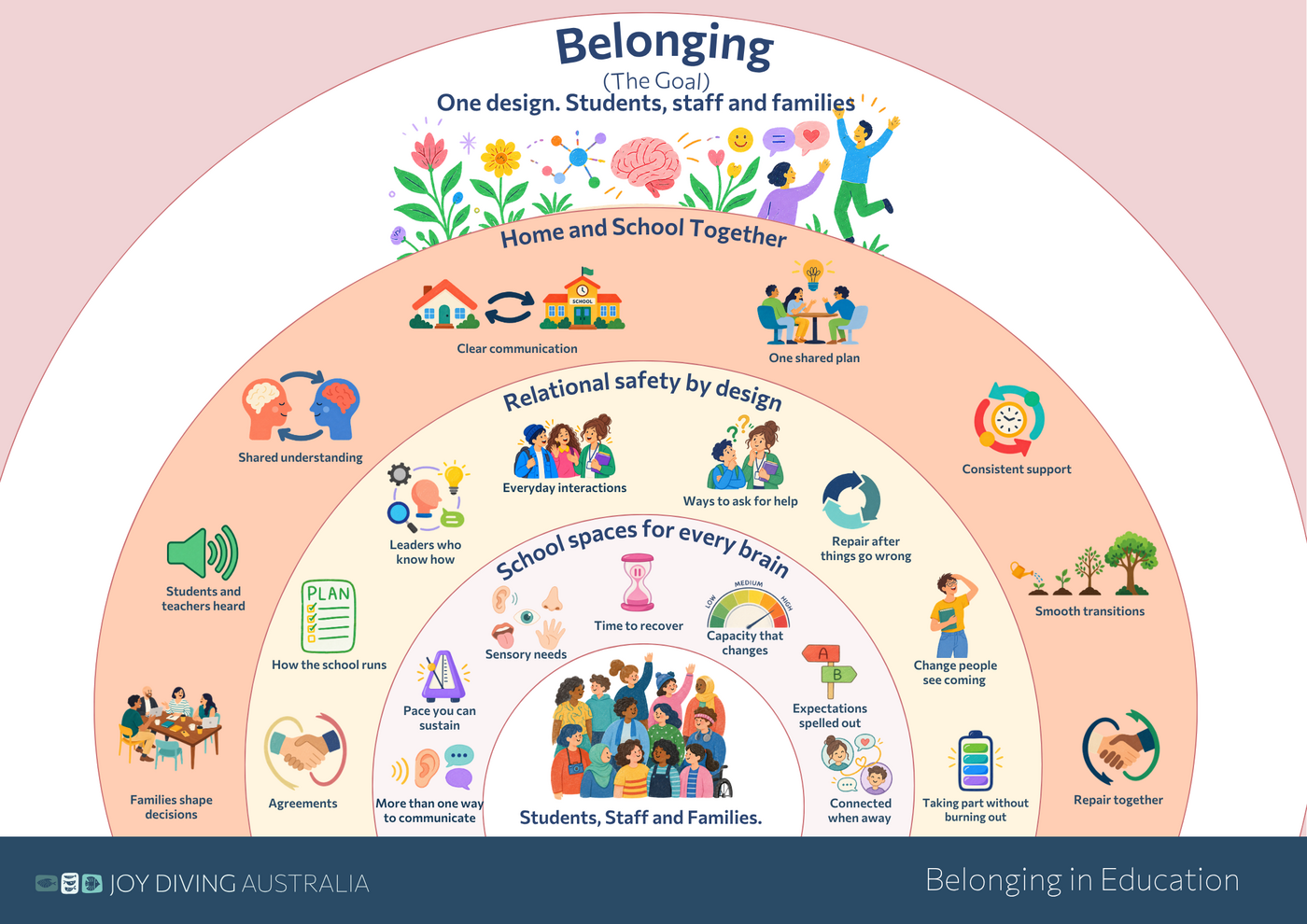
For the wall
Put the Belonging Model on Your Wall
A print-ready A2 PDF of the framework you just read, applied to schools, families and students. Personal or organisational use. $29.
See the Education PosterWhat a School Can Do About It
Keynote, training and workshops for staff, leadership teams and school communities, using the Belonging Model.
A design review of how a school's existing setup affects students, staff and families of every neurotype. It starts small. One review of one thing, the newsletter or the interview night, and a short list of what to change.
Families are already voting with their feet. In a 2024 national parent survey, 47% had changed schools at least once, and 35% had been discouraged from enrolling or refused (Autism Awareness Australia, 2024). A 2021 survey found 34% had changed primary school because the school could not support their child (Thom-Jones, Gordon and Mizzi, 2025). The same researchers note that the adjustments that matter most, a low-sensory space and being allowed to leave the room, 'cost very little'.
A school is also a workplace. For the staff side of the same design, see All services. It covers psychosocial risk review, sensory and workspace design, manager training, and design partnership.
Why One Label Is Never the Whole Story
Inclusion work usually arrives one label at a time. Autistic. First Nations. A parent. LGBTQIA+. Each gets its own policy and its own training, and each is a real improvement. But nobody is only one label, and the labels do not sit side by side. They sit on top of each other and change each other.
This is intersectionality. When someone carries more than one of these identities, they do not get two sets of barriers added together. They get something different, that a plan built for either identity on its own would miss.
A First Nations autistic boy is not an autistic student plus a First Nations student. He falls between two supports, each built for someone who is only one thing.
A parent or guardian with AuDHD (autistic and ADHD) and a chronic illness is not an autistic parent plus an unwell one. Advance notice helps one and flexibility helps the other, and a school can usually offer one or the other.
A Black non-binary teacher is not two boxes to tick. The school's cultural inclusion work may assume everyone in that group is straight, and its LGBTQIA+ work may assume everyone in it is white.
Neurotype exclusion rarely turns up on its own.
Neurotype exclusion is what happens when a school is designed on the assumption that everyone processes, communicates and regulates the same way. It combines with culture, disability, language, money and gender in ways a single-label policy will always miss.
Who Can Safely Speak Up
Positionality is where a person sits in a system, and how that shapes what they notice, what they assume, and what they can safely say.
Take a child who keeps getting sent out of class. A principal can change the rule. A teacher can raise it, and it may be read as not managing their room. A parent or guardian can raise it, and their child goes back to that classroom tomorrow either way. The student can say it is not working, and risk being called defiant for saying it.
Same problem, four positions, four different costs. The less power someone has, the more it costs them to name it. That is why the school goes first.
It applies to the model too. Anyone writing it from one seat, one neurotype, one culture, one set of school experiences will build blind spots into it without meaning to. A school does the same with a newsletter or an interview slot. That is why the model is made to be argued with. People with different lived experience test it, argue with it, and change it. Findings that do not fit are kept, not thrown away.
The accommodations a child receives depends on 2 things, the quality of the principal and the ability of the parent to advocate for their child.
Parent of an autistic student, in Thom-Jones, Gordon and Mizzi, 2025
Where It Breaks Between Home and School
Everyone in a school is working inside limits they did not set. Time, funding, staffing, class sizes, waiting lists, and rules made somewhere else. None of what follows is anyone in the building not caring.
Information goes out. Some of it arrives. Little of it comes back.
When a parent raises something, the usual path is an email, then a meeting, then a report, then another meeting. The Senate inquiry into school refusal found that almost every parent who gave evidence had already sought help from paediatricians, psychologists and mental health services (Senate Education and Employment References Committee, 2023, para 2.12). By the time a formal complaint is the only route left, the relationship has usually already gone.
So both sides are short of the same things. Time, information, and a way to say what is not working before it turns into a complaint. Without that, an unanswered email can be misunderstood as not caring, and a parent who stops coming in can be misunderstood as not interested.
When Something Goes Wrong
Something will. The question is whether a way to put it right already exists before it is needed.
Two things have to be true. What a parent or a student reports is information, not an opinion to be managed. And the school goes first, because the person with less power cannot open the conversation without carrying the risk of it.
The school carries the information. Not the family. No repeating the same history to every new teacher, and no parent left as the only person holding the whole picture.
Where there is no way to put things right, nothing stops. Students disengage, then stop coming. Staff pull back, then leave. The reason gets recorded as something else.
What the Model Does Not Claim
Some parts of a school cannot be changed. Bell times. Class sizes. Exams set by someone else. The building. The model does not claim every condition can be redesigned for every person.
But most limits turn out to be smaller than they looked. So the first step is to show that a thing cannot be changed, not just say it.
Where a limit is real, three things are still owed.
- Say so plainly, as a choice the school has made, not a standard someone has failed to meet.
- Believe the person about what it costs them. A real limit does not make the cost unreal.
- Plan for the harm before it happens, rather than improvising after.
Do those three and it is a real limit. Skip them and it is a choice not to change.
Who This Is For
School Leaders
Who want fewer individual plans and more design that works for everyone from the start.
Teachers and Support Staff
Who are carrying adjustments one student at a time and want the load to sit in the system instead.
Parents or Guardians
Who are tired of explaining the same thing every year to a new teacher, and want to point at a model instead. Send this page to your school.
Students
Who are tired of being the one who has to adapt.
Who Built It
The Belonging Model was developed in Australia by Sarah Eagle, founder of Joy Diving Australia, from more than 25 years of lived experience, practice and research.
